 It’s getting closer, and the authorities seem powerless against these militants.
We are surrounded by terror now, Iraq in the North, and Saudi in the East, both just about 4 to 6 hours away from Bahrain by car. The British Embassy in Bahrain last Wednesday issued a warning to their citizens on the island to be very vigilant, the American Embassy I suspect has issued a similar warning to their citizens. It is not unlikely that we will have terror attacks here as well.
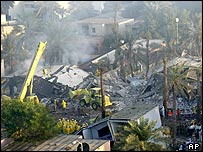
No one knows how many innocents perished last night, but if it is even one, then it is one too many.
What’s the point of this? Is it legitimate for these people to resort to violence? Do they feel so disenfranchised that violence is the only way they have to express their opinion? If they had more avenues of self-expression would the terror stop? What do they want? Wh0’s behind them and who are their supporters?
Too many questions without ready answers, but looking at any struggle in history it must be a culmination of several factors and demands the most important of which is to gain the upper hand, power; they want to demonstrate that they have the power to force a change in the political and social systems, thus forcing the government to take their demands seriously. Will governments to capitulate to their demands? There is not much chance of that happening because if governments did acquiesce to their demands then it is also accepting the dictum of violence and blackmail.
Why is the Middle East in particular prone to these attacks, and why now? The escalation of terrorism in this area of the world has increased to unprecedented levels in the past few years. So what changed?
The terrorists (freedom fighters to some of course) do not see that the governments they are living under as legitimate, and this is the crux of the problem. There is no country in the Middle East that can be called a democracy, at best they are all autocratic hereditary kingdoms (yes and I include Egypt, Syria, Libya… all of the 21 countries) who have taken power by force all those eons ago entrenched by the Ottomans and then the British and French. The world powers continued to prop and maintain militarily and monetarily for their own motives, and now we’re paying the price. But what price? This is the most unstable region in the world with an immense divide between the rich and poor, between the educated and the illiterate, between the ruled and the rulers, and most importantly with almost no real sharing of power.
How do we survive these events? The answer is quite complex I’ll grant you, but a move to a representative parliament must be one of the answers. Some would argue that we’re not ready for democracy because our culture and way of life. I don’t think so. The same argument was used against democracy in Japan and Germany, look at them now. True democracy will immediately bring turmoil, most probably Islamist rule, and general mayhem, but fearing these effects should not be used as the excuse to curtail democracies and freedoms even further. The balance must be nurtured and allowed to develop, only then I think that terrorism will be wiped out.


Comments
Terrorism Research Link
I’ve been looking into the terror phenomenon over the last couple of days, trying to find out the its types, motives, and why now. One site I came across is Terrorism Q & A and well worth the visit. In it, the cause of terror could be:
While I haven’t come close to reading most of the content of this site, I would recommend it as a starting point in anyone’s research into the subject. And although I don’t agree with some of its definitions and conclusions, and some of the content is clearly historic or superceded (as in Iraq), it is still a good resource.