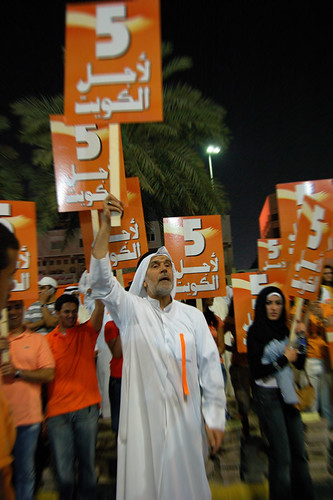
5 for Kuwait – Abbas, originally uploaded by iDip.
Well done Kuwait. You have once again shown the Gulf how to go about grabbing one’s political rights and doing it in a way that avoids violent confrontation and changing it into an occasion where everyone: women, men, and children can participate in and enjoy, while ensuring the maximum coverage for your demands.
Kuwaitis were demonstrating in force (for a country that is not used to such demonstration, the number of people who did show up, about 400 evenly divided as well between men and women) in favour of reducing their electoral districts from the current 25 to 5. They feel that by reducing the number, they will eradicate corruption to a large extent, and also ensure that MPs reach parliament not because of their ethnic or tribal background, but will reach there because of true votes cast for them by a better sampling of Kuwaitis.
Kuwait is a unique society in which slightly more than 50% of its populace are of nomadic (bedu) origins and who traditionally live outside of the city, on its perimeters, while the remainder (hadhar, civilians) live in Kuwait city and other major cities. They feel that having 25 districts geographically distributed around the country favours the bedu and their sometimes extreme voices within parliament (please correct me if I’m wrong) and also as the voting structure is very tribal, MPs get into parliament on their own recognizance and political beliefs, but simply because of the tribe/ethnic background they belong to.
Reducing the number of districts would mean that the geography would now change and would immediately eradicate the biggest problem, ie, tribal voting, hence would get better people into parliament.
Good luck Kuwait!
What interest me in this is that this is the year that Bahrain will have both municipal as well as parliamentary elections, both look like they’re going to happen in the second part of the year, and no definite dates have been announced. I have no idea what the political motive for the delay and not announcing such important dates. But I can tell you that the 2nd half of the year is possibly the worst to have these elections in; summer = almost everyone is off the island, then soon to be followed by Ramadhan = the whole Muslim world, let alone Bahrain, will be comotose for a whole month, and will require another 30 days just to recover. The government might as well introduce drugs in the water system and it would receive much more active participation!
Add to that the really screwed up geographies and demographics of the electoral districts in Bahrain and you would get the picture. Briefly, one voter’s vote in the Southern electoral district is equivalent to THIRTY THREE votes in the Northern district! You would think that with this glaring imbalance something would be done, at least through our currently elected representatives in parliament, wouldn’t you?
Well some tried (arabic | translation), just to get the Services Committee throw both suggestions out due to procedural as well as legal issues. Law by Decree 14 which stipulates and specifies the political rights of individuals specifically states that only the king can specify these districts!
The demographic and physical distribution of our electoral districts are unjust and must be changed if social justice is to be respected in Bahrain, heck, if us as Bahrainis want to start to respect ourselves! How can we respect ourselves if we know that we are disproportionally represented in an institution that is supposed to look after our rights? How are we to respect ourselves if we know that a fellow citizen is worth THIRTY THREE times less that another? How are we to respect ourselves – in this day and age – when you know that the only motive to this distribution is sectarian?
We need to change this. We need to mount a concerted effort to enable the peaceful change of this particular distribution, and the best way I think of doing so is applying pressure to our elected officials.
We must ensure that our voices are heard, and now the Kuwaitis have shown us one effective method of doing so.
Thank you Kuwait, again!


Comments
Note how everything looks so organized. They have professionally printed banners, a general theme for the campaign, a unified color, and a very clear message.
Now contrast that with what we have in Bahrain, where a bunch of unorganized folks hold cloth home-made spray painted banners which doesn’t really tell you anything except that they want to object for the sake of objection.
If I was in Kuwait I would probably help organize that event… in Bahrain I wouldn’t even go near a demonstration. Why don’t we just speak up and create an organized branded and transparently managed campaign for what this country really needs: The deposition of the Prime Minister.
Let’s not kid ourselves and complain about lack of jobs or inequality of electoral districts when we know the majority of the problem is with just one man in the government. And don’t run it from the shadows.
Organize a campaign and be open about the facts everyone is talking about in closed quarters… and I’ll be right there wearing whatever color you want me to wear.
I think in this day and age branding is very important. The leaders in this of course was the Ukranians with their Orange Revolution followed by the Lebanese, the Egyptians and now the Kuwaitis. The unified picture makes it more amenable to be broadcast internationally as the image gives the impression that it is a premeditated and organised demonstration with relevant backup from the community.
We have a lot of issues in Bahrain, you’re right, but I differ with you where we should start. Although the prime minister is hated here, and a lot of scorn is poured on him due to the huge conflict of interest he perpetuates, our first and foremost problem is the constitution, rather than individuals. Once the constitution is fixed, corrupt people and practices – no matter where they are – will have no where to hide.
And how is the constitution going to be amended? When we can freely talk about its issues without the fear of apprehension or harassment. This can happen only if we have a proper freedom of expression without the acute restrictions the parliamentarians themselves are trying to impose. The very same people placed in those positions to protect, if not enhance our freedoms.
Now as to colour: orange has been done, red has been as well as yellow. I vote for a heart-stopping-eye-popping lime green!
You’re right about the coherent turnout “e”. Well done Kuwait. I really hope this is something that catches on Mahmood.
Actually I was thinking about this just the other day…while jogging of all times… we need more organized and coherent events – they dont have to be loud demonstrations, just neat posters, a couple un-ambigous points, (dont let Steve write them…), and a unifying symbol. Maybe a sign up sheet for a mailing list.
I have lost hope for Saudi. But I think this can really REALLY take root in the Trucial States. And if they follow the lead of the UAE, (or a similar model), they could probably even expand the current 7-state Federation.
One of these days I want to schedule a one-month sleep over at a houses of the big wigs, just to see what the day to day lives are like.
-Ibn
I don’t think it’s always that unorganized in Bahrain. Think back to the “Constitutional reform first” campaign that they had here. It was all branded just like this case. And at the protests there were tens of thousands of people marching in an organized fashion chanting that slogan.
But what I think is more important is that the people who participate in these protests don’t come from just one social section of the population. In the case of consitutional reform demonstrations, it was overwhelmingly Shia Islamist, with just a small presence of Sunnis or Nationalists. So in this regard I think the organizers need to make more of an effort to reach out beyond the Shia Islamist crowd, while the others need to make more of an effort to get involved and respond.
Although the PM is by no means the only source of problems here, I do agree that there needs to be some public pressure on him to at least be held responsible for his actions. If nothing else, we should be able to criticize him publicly.
The last time that this was done was about a year and a half ago. Have a look at some of the signs in these photos. I have to say at the time I was quite surprised that people were willing to carry them around in public.
http://photos1.blogger.com/img/242/898/640/100_2956.jpg
http://chanad.weblogs.us/img/0410/191/640/100_2856.jpg
http://chanad.weblogs.us/img/0410/158/640/Picture_033.jpg
http://chanad.weblogs.us/img/0410/191/640/100_2830.jpg
http://chanad.weblogs.us/img/0410/191/640/100_2869.jpg
http://chanad.weblogs.us/img/0410/162/640/Picture_012.jpg
http://chanad.weblogs.us/img/0410/162/640/Picture_049.jpg
(I hope all these links dont set off the spambuster)
I am with Chanad. Knowing diddly squat about the politics in Bahrain (and learning each time I visit here) I can say as a poli sci person that consensus is the best way to forge ahead. You guys do need to get a wide cross section of the population behind any issue for it to be considered.
I don’t know what the differences are between the various groups in Bahrain, but starting off finding common grounds is step number 1.
When I did live in Saudi, I learned one of my life’s lessons. I found myself not belonging to any group but circulating between different ones (western expat, asian expat )and I found that in each group, you had those with an outward , open minded attitude, and those who only wanted to stay within.
Find those outward looking types in each group and proceed from there,
that’s the strategist in my talking anyway
Ingrid
Chan’ad you raise important points. The examples you raise are very valid and I should have considered them more fully. Thinking back on it now, the demonstration we both went to organised by Wa’ad and Wefaq by the Pearl Roundabout comes to memory that before the march began, the organisers came on the loudhalers and dictated the rules of the march which everyone should abide by. They also brought with them a good quantity of Bahraini Flags, placards and banners. The organisation also included designated marshals for the march as well as remote speaker bearers made to march in equal distances from each other, hence ensuring that everyone hears the message being broadcast from the head of the march.
What makes the Kuwaiti demonstration, the Lebanese and the Egyptian as well just “click”? Obviously the Bahraini demonstrations as you reminded us and as I have recalled above are as well organised; so is it the message, delivery or participants that makes the Bahraini “flavour” different?
Of is it indeed that I personally am looking at our demonstrations with a view which should be re-examined? Soul searching and as of now I don’t have the answer as I have to re-look within myself to come to terms with why the situation is as it is from my personal point of view.
That notwithstanding, the generic makeup of Bahraini demonstrations certainly need expansion. Almost every single one we have had was demands for better treatment of Shi’a, better rights, and better representation. Although the secular Wa’ad is constantly in the fray regarding these issues, and although some of its members are Sunni, the general rule in Bahrain is that demonstrations are rather polerised: Shi’a – being historically subjugated, are more concerned with rights, while the Sunnis generally couldn’t be bothered to come out in any demonstration, the vast majority of them – it seems – are happy where they are in their station in life, those who do come out and demonstrate so far are almost exclusively of the extremist salafi/wahabi persuasion or at least their sympathisers.
This leads me to believe that there is a disconnect in society that needs to be addressed; and ways to bring both together to the realisation that they share the same fate should be explored. After all, if a law is promulgated or a constitutional amendment is enacted it will affect everybody in the island regardless of sect, religion or sexual persuasion.
Thanks again Chan’ad for bringing this to our attention, and if I may say so, you should definitely pick up the pen again and start to blog more often!
While I sympathize with these Kuwaiti protesters and laud their method, I’m not so sure that their objective of redistricting will solve the problem. Basically, redrawing the districts to favor the hadhar over the bedu is gerrymandering. While cutting the bedu out of the political process may be a tactical victory, I fear it would be a strategic error in defeating Islamic extremism. If the bedu can not achieve their goals within the political process, they will pursue them outside of the political process. Cutting the bedu out could be paving the road toward an Islamist revolution.
I favor giving them a fair representation within the political process but actively confronting them within that process to defend their ideas. It is their ideas which need to be defeated through free speech rather than thwarted through gerrymandering. This would be part of a larger effort to construct a secular philosophy of modernity for the Muslim world which can rebut the Islamist arguments and defeat their cause. The Kuwaitis should make their parliament the public arena where these ideas do battle.
Steve
Steve I might have interpreted the situation incorrectly, I await confirmation by a Kuwaiti if indeed this is the situation.
After reading some of their blogs today, I realise that this redistribution is to stop the buying of votes which looks like it was a prevalent custom especially in the smaller electoral district. So the reduction in districts and by definition their geographic area increase would put that issue to bed, and be a fairer distribution of the electoral process.
Steve says:
Basically, redrawing the districts to favor the hadhar over the bedu is gerrymandering.
I disagree. It would seem Kuwait’s districts are ALREADY gerrymandered, since each district seems to already curiously favour one tribe over another. What the proponents are trying to do is un-draw the lines of those districts, so that:
1) Tribal origins become irrelevant
2) The districts are more “spread spectrum”.
This is the opposite of gerrymandering. Effectively, the tribal voices are watered down, per district, (as are the hadhar voices) and there is more to offset to their views within that district. (Hence the fight for ideas).
Cutting the bedu out could be paving the road toward an Islamist revolution.
Also disagree. The bedu are not being shunned out of the political process, any more than Nazis in the USA are shunned out of the political process. Yet we do not see Nazis holding a beer putsh anywhere, even though they can never seem to win an election. False analogy.
“Cutting the bedu out” means telling the bedu “you cannot vote because you are bedu”. That’s different. Redrawing districts such that they do NOT favour one sect over another is the opposite of gerrymandering, and has not infringed on bedu’s rights of privileges in any way.
-Ibn
Steve, you seem to be implying something in your statement
You said:
(i) This seems to imply that that the opinion of a bedu is not valuable, or may even be detrimental.
(ii) Here you seem to imply that bedus are inherently inclined towards “Islamic extremism”, moreso than citydwellers.
Just wondering… what are these assumptions based on? (Or if I have misinterpreted, please clarify).
Hi, Mahmood. Thanks for featuring the 5 For Kuwait “campaign” I say it with quotes because it was organised informally by individual caring Kuwaitis working through the internet (blogs) and through word of mouth.
Anyway, I just wanted to correct you about the Bedu vs. Hathar. Backers of this campaign are from all of Kuwait’s areas and from all social sectors.
The big objective in Kuwait these days is to reduce the amount of corruption that occurs within the government (both the ministries and the parliament). This corruption has lead to public cynicism and apathy regarding the government and the role of the parliament. Even worse, it led to pessimism and fatalistic attitude about Kuwait’s future.
The call to reduce the number of constituencies (from 25 to 5) is a step towards reducing that corruption.
The 5 proposal aims to:
1. Make it hard for votes to be bought, or for voter information to be shifted around. Since the votes per constituency in the 5 would be much higher than the 25, making it harder to manipulate the results.
2. Ensure the most equitable distribution between the constituencies. Of all the proposals, the 5 ensures the least difference between the largest and smallest constituencies. Hence have a more representative parliament.
Some are raising issues such as the badu vs. hather and other proposals such as 10 instead of 5 constituents. There are even calls to have just one electoral area. However, that’s simply just to create confusion and delay the government from making a decision in time before next years election – ensuring the status quo and hence securing seats in 2007 for the corrupt faction. The 5 is a proposal that took an independent committee 6 months to come up with. It is the most comprehensive of all current proposals.
“5 for Kuwait†has reinvigorated a sense of patriotism and a common love for the country. The demonstration on Friday (more to come) attended by all segments of the Kuwaiti society has rippled out to touch many others – including you from dear Bahrain! It has given a voice to the young and old, gave us all a hope to make a difference, and the belief that the future is ours.
We all want more representation in determining the future of our countries, and I hope for more reforms in Bahrain and other neighbours soon.
Thanks again, please visit ساØÂØ© الصÙÂاة and 5 For Kuwait if you’d like to keep up with the latest. There was a nother big rally tonight – where well-known and respected reformers spoke out in support of the 5.
Warmest gratitude
Thanks Wonders, very much appreciate your input and we all wish you the best of luck, Kuwait deserves better and more of it, being the leader in democracy in this area, we have a lot to learn from you.
Good luck!
Electoral districts are key and their structure can lead to the most entrenched misrepresentation. In Canada it has led to the existance of a federal party whose primary goal is the break-up of the country.
So it would seem, Will…
-Ibn
Ibn
Are you suggesting that it is otherwise or are you chiding me for stating the obvious? I suppose it doesnt add much to the conversation. Sure is nice to see the wheels of democracy in action.
…I think you’re taking this the wrong way Will. I am in full agreement with you. Sorry if it came out the wrong way.
-Ibn
Chanad: “You said: ‘While cutting the bedu out of the political process may be a tactical victory […]’
(i) This seems to imply that that the opinion of a bedu is not valuable, or may even be detrimental.”
My point is that cutting the bedu out of the political process may reduce their political influence, and presumably mute the radical agenda, in the short term but could build a political power base for radical Islam outside the government.
If you read the rest of my post, I clearly say the bedu should be included in the government.
Chanad: “[You said:] ‘[…] I fear it would be a strategic error in defeating Islamic extremism. If the bedu can not achieve their goals within the political process, they will pursue them outside of the political process. Cutting the bedu out could be paving the road toward an Islamist revolution.’
(ii) Here you seem to imply that bedus are inherently inclined towards “Islamic extremismâ€Â, moreso than citydwellers.
Just wondering… what are these assumptions based on? (Or if I have misinterpreted, please clarify).”
As the extremist version of Islam came from bedu, my assumption is that the bedu of Kuwait would favor it, that their desert heritage lends itself toward a severe view of religion and life in general.
Steve
just a small explantion
redistricting it not meant to cut off badu
redistricting is meant to have more voters per parliment member
so it would be harder for a memebr to give favors to some to win
or buy votes
having more voters per parliment member is better for badu , because they vote by tribal name , but for others they can’t depend only on their family name , they have to be good , real good and in that case badu will have to pick better canidate because they can’t depend on their tribe only to win
Steve said:
It is this type of essentialist tendency that I find quite bothersome. What if I were to say the following?:
Faulty induction??
Chanad,
You are right. Steve’s conclusion is faulty, because its premise its faulty.
Just because A –> gives B, does NOT mean that B –> gives A.
This however, is typical of Steve’s mindset. Tell him some poison comes from snakes, and he will assume all snakes are poisonous.
He has said:
As the extremist version of Islam came from bedu, my assumption is that the bedu of Kuwait would favor it, that their desert heritage lends itself toward a severe view of religion and life in general.
One would be inclined to think that the founder of Islam, Mohammad, would also be an “extremist”, since he was obviously a bedu, according to Steve’s wording.
There is also another point that Steve should consider:
There is a big difference between rural people from far off farming communities who choose to live a life of extreme piousness and religion away from civilization, and between imperial global terrorists who have major political objectives, and are using Islam to justify their goals.
Its a comparison of apples and oranges. Lumping both together on the grounds that they are both “conservative” is a grave error at best. Not every pious Muslim is a terrorist, hence, it does not follow that bedus who are conservative, are also terrorists.
Chanad, the exact name of Steve’s fallacy is “Affirming the Consequent”.
Here it is in more detail:
http://www.fallacyfiles.org/afthecon.html
-Ibn
Chanad, you’ve made quite a point of disagreeing with my rationale for assuming that the bedu favor Islamic extremism but have avoided disagreeing with the point itself. If my assumption is false, here is your chance to educate me. If I learn something here, I’d be happy to see you win your point.
Ibn: “One would be inclined to think that the founder of Islam, Mohammad, would also be an “extremistâ€Â, since he was obviously a bedu, according to Steve’s wording.”
Yes, that’s exactly correct. There is ample evidence to show that Mohammed was an extremist, head-cutting, violent religious extremist. His dying position was that he would fight every man until the whole world worshipped Allah. The Sep 11 skyjackers were simply following his example and carrying out his commands.
Ibn: “There is also another point that Steve should consider: There is a big difference between rural people from far off farming communities who choose to live a life of extreme piousness and religion away from civilization, and between imperial global terrorists who have major political objectives, and are using Islam to justify their goals.”
I did not argue that bedu were terrorists but rather that they favored religious extremism.
Ibn: “Its a comparison of apples and oranges. Lumping both together on the grounds that they are both “conservative†is a grave error at best. Not every pious Muslim is a terrorist, hence, it does not follow that bedus who are conservative, are also terrorists.”
Here is a classic example of Ibn changing his opponent’s argument into a scarecrow he can throw rocks at. I never argued that all bedus are terrorists, as you falsely claim, again. I argued that bedu favored Islamic extremism, with which you seem to agree when you delicately call them “conservative.” Again, Ibn, try arguing with the actual positions I hold rather than the ones you invent for me. What is so difficult about that for you?
Ibn: “Chanad, the exact name of Steve’s fallacy is “Affirming the Consequentâ€Â.”
Not really. I think any possible error I made in assuming all bedu favor Islamic extremism would be a “sweeping generalization,” where you take an instance and overgeneralize its individual properties to a category. In this case, the possible error would be saying that since some bedu are religious extremists, all bedu are religious extremists. Maybe Chanad will present some devastating evidence to the contrary, perhaps bedu devotees of Ghandi who advocate non-violent resistance.
However, I applaud your research into logical fallacies and hope you will extend it to rational arguments as well. That will improve your arguments quite a bit. When you get to college, you should take a course in logic your sophomore year. Failing that, you might try a book like “A Rulebook for Arguments” by Anthony Weston.
http://www.amazon.com/gp/product/0872205525/sr=8-4/qid=1147056253/ref=pd_bbs_4/002-7597671-3132848?%5Fencoding=UTF8
Steve
Steve, I’m not sure that bedu in general are more inclined to extremism, religious or otherwise. Sure they live(d) in a harsh environment and some might continue to do so in this day and age during weekends where they live in pseudo-tents with all the mod cons, including portaloos and satellite entertainment.
Is there actual research from the field which shows us the demographics and the way of life of the bedus in these modern times? I have a Bahraini friend who lived with the bedus of the Sinai desert for 3 months and made a documentary of the experience, maybe she should comment on the bedus in that area. Someone else who knows the bedus of the Gulf could comment on them as well, as they might be different.
What I see here is us all falling into stereotypes which are just unsupportable.
Come on, let’s get the research going.. maybe we could make a movie out of this experience!
Steve said:
I am far more concerned about your reasoning, because I’ve noticed that you tend to apply this type of weak induction to alot of issues. Moreover, it is exactly this type of flawed reasoning that many Muslims will use to condemn all Americans as being greedy and immoral, for example. I hope you agree with me on this.
On the point of whether bedus favour Islamic extremism, quite frankly I don’t know enough to make a strong claim for or against. But there are a few things that can be pointed out. First, “Islamic extremism” — by which I assume you mean Wahhabism — is more closely associated with Najdis. The Najdis happen to be mostly bedus. But all bedus are not Najdis. There are bedus in North Africa and elsewhere who practice a mystic/Sufi version of Islam. Even some of the tribes in the Gulf that are of bedu origin practice traditional Sufism.
The theoretical link that you suggested between a “severe view of life and religion” and a “desert heritage” is one of your imagination, and not based on a serious investigation… certainly nothing serious enough to warrant such a huge generalization, you will admit I hope.
There are muslim citydwellers who have no such “desert heritage”, yet they too adhere to an extremist version of Islam… even white American muslims from California, for example. And there are even some strong reasons to suggest that certain citydwellers would be inclined to extremist ideologies.
Again, I don’t know what the correct answer is. But I do know that it’s not right to throw around such highly uninformed assertions in a discussion that we claim as being mature and serious.
Steve its nice to see you post Weston’s book. Have you read it? I haven’t read it but would imagine there is something in there on rebuttals.
billT “I would have to say that following your own reasoning in regards to Muslims that you are a terrorist since you knowingly turned a blind eye to the growth of a WMD that kills thousands each year and that some of the money goes to fund terrorist organizations”
Is it possible that your silence means the vast majority of Muslims arent guilty of 9/11 and all liberals dont hug trees and eat veggies. 🙂
Chanad: “Moreover, it is exactly this type of flawed reasoning that many Muslims will use to condemn all Americans as being greedy and immoral, for example. I hope you agree with me on this.”
Of course, I agree. Some Americans are greedy, some immoral, but not often both simultaneously.
Chanad: “On the point of whether bedus favour Islamic extremism, quite frankly I don’t know enough to make a strong claim for or against. But there are a few things that can be pointed out. First, “Islamic extremism† by which I assume you mean Wahhabism  is more closely associated with Najdis. The Najdis happen to be mostly bedus. But all bedus are not Najdis. There are bedus in North Africa and elsewhere who practice a mystic/Sufi version of Islam. Even some of the tribes in the Gulf that are of bedu origin practice traditional Sufism.”
That is an interesting point, Chanad. I wonder if any readers could elaborate on it. Are the Najdis an anomaly among bedu or the norm?
Steve
billT: “Steve its nice to see you post Weston’s book. Have you read it? I haven’t read it but would imagine there is something in there on rebuttals.”
Nope, haven’t read but did order it. It looks like an intro book to logic. I taught a section on logic for a few years as part of a GMAT prep course, so I prefer to cut to the chase and read the books with the classic forms of reason and rhetoric.
billT: “I would have to say that following your own reasoning in regards to Muslims that you are a terrorist since you knowingly turned a blind eye to the growth of a WMD that kills thousands each year and that some of the money goes to fund terrorist organizations.”
Actually, I have answered this question several times for you. I haven’t turned a blind eye to it, but rather I believe that your approach will not solve the problem but rather inflame it. If you divert our troops from securing the government in Afghanistan to chasing poppy fields, our effort there will fall between two stools. You can’t do everything everywhere. You have to prioritize problems and work them in sequence.
Steve
Ok then those Muslims who don’t speak out against terrorism for fear of either their government or terrorists or people who are just trying to feed their children and keep them alive aren’t responsible for 9/11. Unfortunately I’ve been on this site long enough and read your posts long enough to know that you wouldn’t give a damn if every Muslim died tomorrow. Look at your posts carefully there is a constant pattern of hate and negativity even when the post is considered good by the people who actually live in the area.
Look Steve I’m not so stupid or liberal (just saving you having to use the word) that I don’t know that it would be counter productive to send troops to root out the poppy growing not to mention that some warlord or what ever you want to call him would pull his support for the government if we really got going on it. Like SEA and the golden triangle all over don’t you think.
I’m all for working in sequence so lets try it I’ll go first. Terrorism isn’t a country with borders that we can invade and then land on a carrier with mission accomplished banner flying. Given that what do you think the next step should be?
Pheww!
How did this argument get to this? I got back to check on my post, and now I see it has gone of on a Muslim/Terrorist tangent!
As I said, this is not an effort against a certain stereotyped group of Kuwaiti society. This is for sure a move against electoral corruption. (As forzaq8 pointed out)
Now, if this means that tribal voting is a victim, well yes then the Bedu will be impacted. And some members of parliament are threatened by it, and so they raise the issue of inequality and hence change the subject.
And as Ibn pointed out, Bedu being extremist is a stereotype.
In Kuwait, we have have many Islamic movements: Salef, Distoriah (constitutional movement – muslim brothers), Shiite, etc. Some were united for a few years, and were strong in the parliament. However, they disagreed among themselves a few years ago, and have broken out to different thinking streams. They are still in parliament, and will always be there because they represent a part of society.
Much to the annoyance of liberals such as myself, they are organised and well placed to have an impact. However, I do respect that they deserve equal rights in determining the laws of our country. Just as long as we all believe in multiple voices, and that the rights that are protected by the constitution are not touched.
It has been this ability to have a voice in parliament, rights, the press, and in ensured gatherings all these years that kept Kuwait relatively safe from extremism, which often also lead to violence.
Oops should’ve mentioned that those Islamic movements are strong in Hather, and in fact strong in members of prominent families.
Thanks, Wonders. I get your point that not all bedu are extremists and some hather are. So is the extremist sentiment evenly spread throughout Kuwaitis of every category or does it have a natural center in one group?
Steve
billT: “Ok then those Muslims who don’t speak out against terrorism for fear of either their government or terrorists or people who are just trying to feed their children and keep them alive aren’t responsible for 9/11.”
Non sequitur.
My position is that every Muslim shares a degree of responsibility for Islamic terror, maybe a tiny bit or maybe a lot, except those who reject it. You are connected to it through your religion and have an impact on the vector of violence, though that impact may be tiny.
billT: “Unfortunately I’ve been on this site long enough and read your posts long enough to know that you wouldn’t give a damn if every Muslim died tomorrow. Look at your posts carefully there is a constant pattern of hate and negativity even when the post is considered good by the people who actually live in the area.”
False. My grievance with Muslims begins with Sep 11 and extends to their imperialist religious war against the world, particularly America. I oppose anyone who kills Americans en masse. When Muslims stop spilling blood to propagate their religion, my complaint ends.
Until that day, I will continue to be a critic of Islam. When Islam respects me, a non-Muslim, I will respect it. To get to that point, Muslims will need to rip the Verse of the Sword out of the Koran and reject Mohammed’s position of fighting every man until the whole world worships Islam. I’m not holding my breath, waiting for that to happen.
billT: “I’m all for working in sequence so lets try it I’ll go first. Terrorism isn’t a country with borders that we can invade and then land on a carrier with mission accomplished banner flying. Given that what do you think the next step should be?”
One thing we can agree upon is that declaring a war on terror frames this war incorrectly and in such a way that it can never end. Terrorism will always be with us, even if we were to stop Islamic terrorism.
So far, we have struck around the periphery of the problem, which lies in Saudi Arabia. While there is a natural propensity within the Muslim world to do religious violence, it is vastly amplified and focused by the Saudis and their money. The best way to cripple Islamic terrorism is to starve it of its funds. That means separating the oil fields in eastern Saudi Arabia from the Saudis, and their clients, the Wahhabis.
We certainly should not invest the lives of our troops to defend a nation like Saudi Arabia, which has proven to be an enemy of the United States and all it stands for. Should we withdraw our protection, Saudi Arabia could fall to a host of threats, a Wahhabi revolution from within or an attack from without, like Iran, perhaps. When the smoke clears, we should set up a state in eastern Arabia that funnels its petrodollars to sensible Arabs rather than the Wahhabi death cult.
We should be shooting to make the Eastern Province independent, more like Dubai and less like Buraydah. When the Wahhabis are starved of petrodollars to export terror around the world they will have, at long last, the opportunity to achieve their dream of retreating into the 13th century.
Steve
Hi, Steve. Fair question, but I don’t have a clear and simple answer. I think this would need some help from a sociologist.
My opinion is that, in general, extremist sentiment –as you put it – is usually within disenfranchised groups. Groups that feel inequalities in many social, economic, and political issues. As you probably know, this in the context of a rapidly changing region allowed for conservative political movements to pop up promising a uniformed better future, based on an idealised past. A bit similar to Christian fundamentalist movements.
So, who’s disenfranchised in Kuwait? I think plenty, but the reasons are diverse. Accept for a few cases, the inequalities are not specifically subjugated to groups. As in any society, there are social and economic differences. Add corruption, and you will get a lot of resentment. Also, there are real issues such as bedoon (not bedu), rights of foreign husbands to kuwaiti women, etc. However, I don’t think that’s what you were asking about. If you were specifically asking about Islamic movements, I think it attracts many individuals for different reasons from all groups. I don’t consider this extremism, I think they call it belief 🙂 It’s when their belief transgress onto others’ rights, then it becomes extreme.
wonders.me
so it is not 5, nor it stayed 25, it became 10 electoral districts. still we are batter than you:)
Hi E-man. Well, it’s not over yet. We still would like the 5. The 10 if the oponents to the 5 look into the details will be shocked at how skewed it is towards certain areas and interests. The government still has till the 15th of May to propose the 10 or another proposal to the parliament. We intend to fight it and show it’s shortcomings.
And..sorry I didn’t get what do you mean by you better than who? 🙂
Ayman, who are the “we” and “you”?